Category: It’s So Random

Random contents that have been streaming from life-hack website.


  • What happens to your body when you sit for too long?

    What happens to your body when you sit for too long?

    Reading Time: 3 minutes

    What Happens to your Body When you Sit for Too Long?

    Taking time to relax and put your feet up is important to maintain self-care, but doing this in excess actually has many negative effects. Even taking the time to decompress from a long day at the office might actually not be as great for you in the long run. Think about it – sitting all day just to come home and sit. Here are some ways that it can negatively impact your body.

    1. Slow Digestion

    Many times, those who sit for long periods of time tend to eat while sitting as well. Sitting down after eating can cause the abdomen to compress and then slow down digestion. Slow digestion can cause several small issues, such as constipation, heartburn, bloating, cramping, and weight gain, if this is a long-standing habit.

    2. Problems with Posture

    Sitting for long periods of time can cause aching shoulders, neck, and back. It can also lead to poor posture which then turns into back problems or strains in the neck and shoulders. The more time that is spent sitting, the more likely it is to slip into a lean or slouch position. Commonly, when at the computer, people hold their neck and shoulders forward, which causes strain on these areas when held for an extended period of time. Sitting also applies more pressure on the back than standing does, and the vertebrae of the back are designed to expand and contract with movement. Long periods of sitting cause the disks to compress and lose flexibility, which raises the risk of a herniated disc.

    3. Leg Disorders

    The term “use it or lose it” applies when sitting for long periods. The inactivity and excess sitting lead to poor circulation, blood clots, swelling, weak bones, varicose veins, and sometimes, in extreme cases, it can lead to osteoporosis. Make sure to stay active and keep the blood circulating. This is easy; if you were watching TV, during commercial breaks, get up and take a walk, or just take a walk once an hour, even when at work. The break will allow you to stretch your legs and get blood flowing, and will refresh you mentally as well.

    4. Weak muscles

    Generally, the more active you are, the stronger you have potential is. Staying active not only allows you to be strong but it keeps you moving, and this maintains flexibility. Resting after a workout can be relaxing, but don’t forget to stretch the muscles, or they will feel tight and make you sore the next day. It is not only the legs that suffer when sitting for an extended period of time, standing and walking require various muscles to be tensed that are not flexed when sitting. Prolonged sitting has the potential to cause muscle degeneration in the abs, glutes, calves, hips, and more.

    How to Avoid These Dangers

    These are a few simple ways to counteract the dangers of sitting for prolonged periods of time.

    • Taking the stairs whenever possible can jumpstart your heart rate and blood circulation.
    • Park further away, take a longer walk on the route to your destination.
    • When in an office, walk to your coworkers or classmates rather than sending them an email.
    • Use a chair without armrests, as this can force you to sit up straighter.
    • Set a reminder to move around for at least 10 minutes every hour.
    • Take coffee breaks, during lunch, or before or after class, and get some time in at the gym.
    • Stretch often and utilize an exercise ball. Small leg raises can be done under your desk instead of using a footrest.

    Turning into a puddle on the couch after a mentally exhausting day might seem appealing, but it does nothing for your physical health. If you have not been able to stretch into your day, consider taking time to visit the gym after work. It will help both mentally and physically.
     

  • I Use My Stand Mixer for Fluffier Mashed Potatoes

    I Use My Stand Mixer for Fluffier Mashed Potatoes

    Reading Time: 3 minutes

    Whatever happened to chunky mashed potatoes? There’s a lot of hype for the silky, nearly pudding-like variety of mash—which seem to be the only kind served at restaurants these days—but for me, nothing beats a heaping pile of fluffy smashed potatoes studded with knobbly bits of soft, uncrushed tuber.

    And if you too are a supporter of chunky mashed potatoes, you can use your stand mixer to get the best consistency.

    Stand mixer versus hand-mashed potatoes

    There is nothing wrong with hand-mashing potatoes, but I’d like to bring stand mixer mashing to your attention simply because after I tried it, I couldn’t help but appreciate the difference in consistency. I hadn’t even expected to feel the difference on my palate—I was only testing out the method to see if it served a practical purpose. 

    Surprisingly, just by scooping a dollop into a bowl, I could feel that the texture was lighter than when I hand-mash potatoes in a pot. (And I didn’t even use a whisk attachment.) I then ate said bowl of spuds, and experienced an airiness that didn’t fade even after it cooled down. Whenever I mash by hand, the potatoes are soft but still dense, and they sit heavily. Not these—this batch was almost whipped, with more consistently sized bits of unmashed potato. (Maybe this is a me-thing, but if I hand mash potatoes for their chunkiness, I usually wind up with a few embarrassingly large pieces that somehow make it through my masher.)

    As far as those practical purposes are concerned, mashing with a stand mixer is great if you need to multitask with multiple dishes, quickly free up the stove after boiling, or if you have limited strength or mobility.

    Regardless of your reasons, here’s how I do it.

    How to make mashed potatoes with a stand mixer

    1. Boil or steam your spuds

    When making mashed, I prefer to steam my potato pieces because it’s faster, but you can stick to boiling if you like. (Steaming only takes about 15 minutes because you only need to boil a half-inch of water rather than a gallon.) The type of potato is also up to you, but I use russets for their high starch content, which can yield a more fluffy mash.

    2. Toss in the hot taters and flavoring ingredients

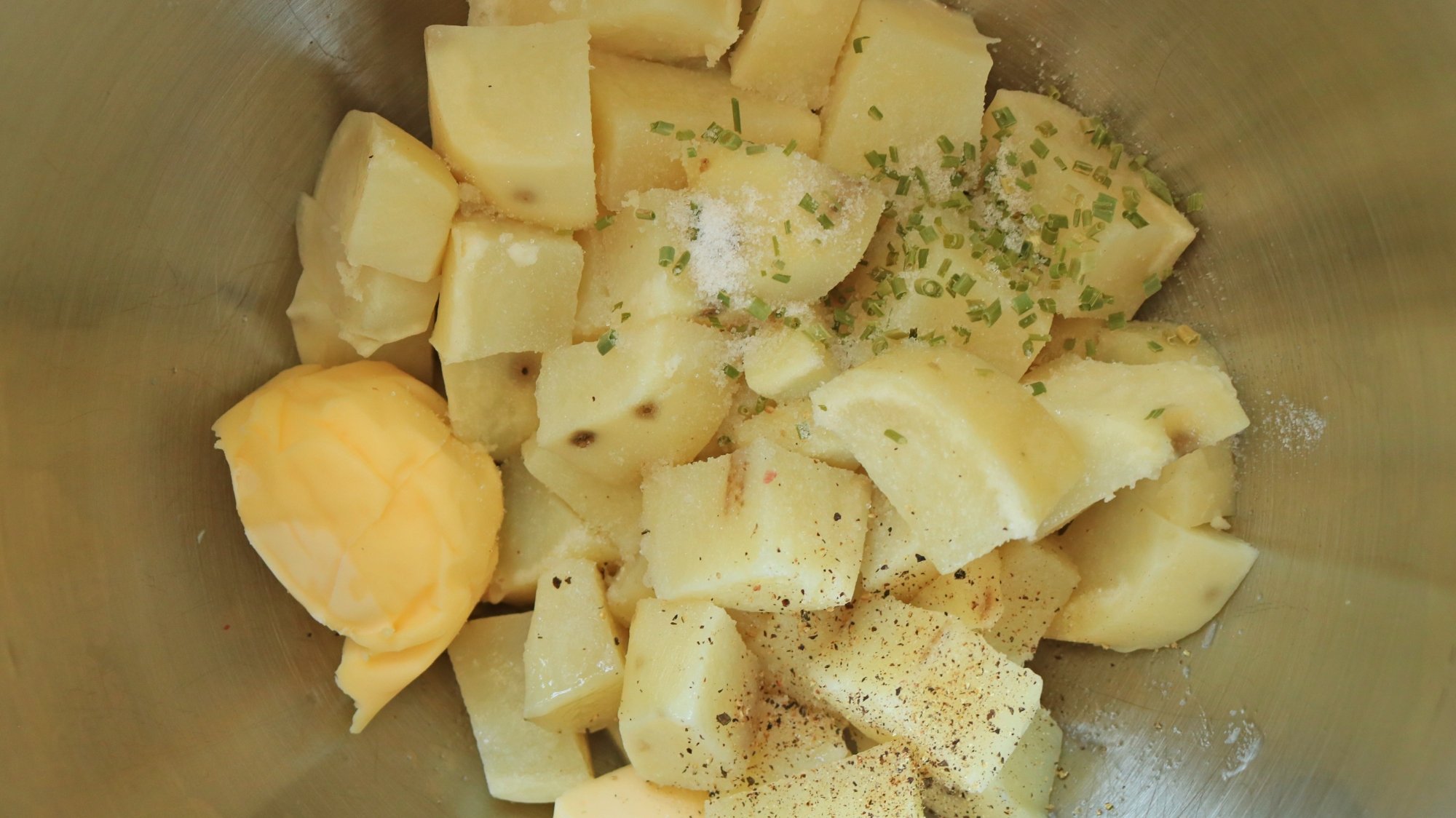
    Cubed potatoes with butter and dry chives in a silver bowl.

    Credit: Allie Chanthorn Reinmann

    Once your potatoes are fork-tender, carefully (don’t burn yourself) toss them into the bowl of the stand mixer. Don’t wait for them to cool down; they should still be piping hot. As America’s Test Kitchen explains in their baked potato post, breaking open the potato (in our case, the potato hunks) while hot allows more steam to escape, leading to a fluffier, lighter texture. Add in your favorite ingredients, a few knobs of butter, some salt, pepper, and chives if you’re into that. Don’t add your liquid ingredient yet.

    3. Mash

    A stand mixer bowl with mashed potatoes inside.

    Credit: Allie Chanthorn Reinmann

    Attach a paddle attachment to the stand mixer and turn the machine on the lowest speed. Allow the mixer to do the work for about three to five minutes. You’re looking for a uniform texture, and for the butter to be fully incorporated. Stop the machine if you have to so you can get a better look at how the potatoes are breaking down.

    4. Add the liquid

    During those three minutes, pour your measurement of liquid (whether it’s milk, cream, or a combination of the two) into a microwave-safe measuring cup. Heat it until steaming. Keeping the mixer on the lowest speed, slowly pour the liquid into the mashed potatoes. Once the liquid has been incorporated, bump the speed up one or two notches and let it mash for another 20 seconds or until you like the texture. Taste, and adjust the seasoning if necessary.

    Top your taters with a swirl of gravy and enjoy the fluffiest chunky mashed potatoes you’ve ever experienced.


    I Use My Stand Mixer for Fluffier Mashed Potatoes
    I Use My Stand Mixer for Fluffier Mashed Potatoes
    Lifehacker

  • 6 Surprising Skin Care Benefits Of Hemp Seed Oil

    6 Surprising Skin Care Benefits Of Hemp Seed Oil

    Reading Time: 3 minutes

    face

    Did you know cannabis can be an important herb? Although it’s normally associated with marijuana and hence illegal, some species within the genus cannabis are beneficial to us. One such species is hemp, or Cannabis sativa. For the longest time, industrial manufacturing of hemp was prohibited, owing to its connection with its cousin, marijuana. However, the ban was lifted once this plant became famous for its benefits. Here are some of them.

    1. It Acts As A Skin Cleanser

    Hemp oil is an excellent choice of cleanser for acne-prone skin. It has a light consistency that helps remove excess oil from the surface of your skin. It clears clogged pores that contribute to breakouts. Just mix one part hemp oil and one part tea tree oil with a few drops of jojoba and lavender oils to get the perfect oil-based cleanser for your delicate, acne-prone skin. This has been a beauty hack widely used by tribal women across the globe, and you’re sure to see great results.

    2. It Treats Acne

    Hemp seed oil has incredible anti-inflammatory properties that help soothe skin problems like acne. Acne is a result of the clogging of pores by excess sebum, causing inflammation of the skin and resulting in tiny, painful bumps. Hemp seed oil clears out the excess oil from your skin, hydrates it from the inside owing to the balance of omega-3 and omega-6 fatty acids, and reduces the size of the bumps, along with the pain.

    3. It Treats Rashes Instantly

    Hemp seed oil is known to be an effective cure for skin irritation and rashes. Also, for other skin reactions like eczema and psoriasis, hemp seed oil is an excellent solution. Just take a few drops of hemp seed oil mixed with tea tree oil on a cotton plug and dab it on the affected area. Within minutes, you will notice that your hives have vanished. Treating rashes is one of the most common and effective benefits of hemp seed oil that we are aware of. It has been a boon for soldiers, hard labor and ranch workers for generations. Though its use has been largely limited in recent times due to lack of availability, hemp seed oil is making a comeback in recent times.

    4. It Reverses Skin Aging

    The presence of polyunsaturated lipids in the form of omega-3 and omega-6 fatty acids helps in restoring skin elasticity. Since hemp seed oil reaches into the deep layers, it helps reset the collagen productivity of your skin, thus keeping your skin soft, supple, and wrinkle-free.

    5. It Is A Great Moisturizer

    Through the course of the day, your skin is exposed to a lot of dust, grime, and pollution. To keep your skin healthy, you need to give it time to recover. So, every night, before turning in and after you have removed your makeup, moisturize your skin with some hemp seed oil. The fatty acids in hemp oil percolate into the underlying layers of your skin, hydrating it from within. They also lock the moisture in and prevent your skin from drying up.

    6. It Alleviates Dermatitis

    According to a study published in the Journal of Dermatological Treatment, hemp seed oil has been found beneficial for treating skin problems like dermatitis. The presence of omega-3 and omega-6 fatty acids in hemp seeds is believed to be responsible for the reduction of the inflammatory response that causes dermatitis.

    Hemp seed oil is used in most beauty creams and products, owing to its amazing benefits for maintaining skin health. Hemp seeds themselves also keep your heart healthy and provide you with the necessary plant proteins. So, indulge yourself in this new and efficient remedy for beautiful, glowing skin!

    Featured photo credit: http://www.thebridalbox.com/articles/blouse-back-neck-designs_0029510/ via thebridalbox.com

    The 6 Surprising Skin Care Benefits Of Hemp Seed Oil appeared first on Lifehack.


  • Video: How Mentally Strong People Come Out About Mental Illness

    Video: How Mentally Strong People Come Out About Mental Illness

    Reading Time: 2 minutes

    Bold white woman office

    Whenever the thought of telling others about my mental illness entered my mind, I felt a wave of anxiety pass through me. My head began to pound, my heart sped up, my breathing became fast and shallow, almost like I was suffocating. If I didn’t catch it in time, the anxiety could lead to a full-blown panic attack or sudden and extreme fatigue, with my body collapsing in place. Not a pretty picture.

    For 9 months, I had been suffering from a mood disorder characterized by high anxiety, sudden and extreme fatigue, and panic attacks. I really wanted to share much earlier. It would have felt great to be genuinely authentic with people in my life and not hide who I am. Plus, I would have been proud to contribute to overcoming the stigma against mental illness in our society, especially since this stigma impacts me on such a personal level.

    Ironically, this very stigma against mental illness, combined with my own excessive anxiety response, made it very hard for me to share. I was really anxious about whether friends and acquaintances would turn away from me. I was also very concerned about the impact on my professional career of sharing publicly, due to the stigma in academia against mental illness, including at my own workplace, Ohio State University, as my colleague and fellow professor described in his article.

    Still, I did eventually start discussing my mental illness with some very close friends who I was very confident would support me. And one conversation really challenged my mental map, in other words how I perceive reality, about sharing my story of mental illness.

    My friend told me something that really struck me, namely his perspective about how great would it be if all people who needed professional help with their mental health actually went to get such help. One of the main obstacles, as research shows, is the stigma against mental health. We discussed how one of the best ways to deal with such stigma is for well-functioning people with mental illness to come out of the closet about their condition.

    Well, I am one of these well-functioning people. I have a great job and do it well, I have wonderful relationships, and I participate in all sorts of civic activities. The vast majority of people who know me don’t realize I suffer from a mental illness. So I decided to come out to battle the stigma!

    My goal is to publicize my mental illness as broadly as possible so that people can see that one can be a highly functioning member of society while still battling with mental illness daily. I am comfortable sharing that I take psychiatric drugs daily and see a therapist weekly. While suffering regularly from bouts of debilitating anxiety and fatigue, I still make it through life successfully.

    I have even written in newspapers about my experience. My hope is that talking about myself will be one small step to fighting the stigma against mental illness. I also hope that it helps empower people to take steps to manage their emotional selves and take charge over their lives through intentional thinking.

    Featured photo credit: Naser Khan/Flickr via flickr.com

    The post Video: How Mentally Strong People Come Out About Mental Illness appeared first on Lifehack.

    Source: Lifestyle

  • Social Media New Year’s Resolutions

    Reading Time: < 1 minute

    63b24e835e0bd1ef9547a7191f2e49e7

    photo credit: Pinterest

    The post Social Media New Year’s Resolutions appeared first on Lifehack.

    Source: Lifestyle

  • How To Organize Your Move

    How To Organize Your Move

    Reading Time: 3 minutes

    Organize Your Move

    One of the most annoying experiences in life is moving to a new residence. There is so much to plan and do, and it often seems like you are still trying to pack and clean on moving day. Many people think that all they have to do is pack up their stuff and they are ready to move. That is not the case. There are many other little details that must be taken care of throughout the process. It is a good idea to have a binder where you can keep all of the important information you will need before, during, and after the move. Here are the things that you should have in that binder.

    Checklists

    The more you have written down, the less likely you will be to forget anything. There are lots of printable checklists online that you can use. Reference these lists as you are preparing to move to make sure that you don’t forget something important. Your lists should include everything to be done before, during, and after the move.

    Utilities

    Make sure that you keep track of all of your utilities, both at your current home and the home you are moving to. Make sure that all utility appointments are scheduled well in advance, and have a list of these appointments and contact information. Unfortunately, in many cases, you will have a rather long window of time when utility companies can show up, so make sure that you have something to keep yourself busy with while you are waiting for each appointment.

    Loan Documents

    You may need to access your loan documents at any time, so keep them in the binder so you have easy access to them. Once you are settled in your new home, find a permanent place to keep them, such as a filing cabinet or safe in your home office. Make sure that they are not easily accessible to others, but that you can get your hands on them quickly when you need them.

    Mover Information

    It is important that you have the contact information for your moving company on hand, because you never know when you will need it. Also, make sure that you have the rental contract in the binder, as well as goods in transit insurance information.

    Receipts

    For anything that you buy in relation to your move and your new home, keep the receipts. Create a section in the binder that is just for these receipts. That way, if you need to return something that doesn’t work or fit, you will have the receipt and there will be no issues later on.

    Builder Information

    If you are having a new home built, or are renovating the home you are moving into or out of, you need to make sure that you have all of the contact information, warranties, and other information about your builder on hand.

    Inventory List

    Print out a “moving inventory list” online and fill it out. This list should include every item in your home. It is a good idea to break the list down into categories, such as by room. That way, you have a list of what needs to be in each room after you move.

    Schedules

    There is going to be so much going on during your move that you could end up forgetting about important appointments. Make a section in your binder for your appointments, your schedule, moving company schedules, etc. You can create a calendar as a Word document and then print it out. Then, all you have to do is write the appointments in the appropriate blocks.

    Featured photo credit: Mary Whitney via pexels.com

    The post How To Organize Your Move appeared first on Lifehack.

    Source: Lifestyle

  • Natural Ways To Treat A Cold In Babies And Toddlers

    Natural Ways To Treat A Cold In Babies And Toddlers

    Reading Time: 2 minutes

    baby

    When young children get sick, it’s easy to panic and head straight for the doctor’s office, which could mean endless waiting in stuffy rooms full of sick people, often exposing you to even more germs and possible illness. Babies get restless and become distressed and this diminishes their potential to heal. While it is imperative to seek medical assistance when fever or infection needs attention, common symptoms like stuffy and runny noses, persistent coughs, and even mild fevers can be treated at home with natural remedies.

    Here are 4 natural treatments to consider.

    1. Good hygiene

    You can start with clean noses and hands. Sometimes, runny noses will drip like taps all day long, and if they rub the mucus into their eyes, it can easily cause an infection like pink eye. It’s tedious, but stock up on tissues and wipe their noses whenever needed. Older children can be taught to do it for themselves and babies older than one will learn to instinctively blow if you squeeze their nose gently to get the mucus out. Wash your own hands frequently with soap and water and clean little hands regularly too. Again, young children love water play and will quickly learn how to do it for themselves. Most importantly is washing after using the toilet, outdoor play, and before meals.

    2. Saline

    Saline sprays and droppers can be purchased over the counter and they are a very effective and non-medicated natural way to unblock tiny noses. Use saline occasionally to relieve stuffiness, particularly before sleep, during a day nap, or at bedtime. Saline will thin out mucus and also cause them to sneeze out the muck. Some come with a rubber and plastic sucker that you place at the nostril to pump out the mucus. It is very effective on newborns and small infants who are unable to cooperate by blowing.

    3. Vaporizers and steam therapy

    Congestion can be eased with steam and vapor. Newborns and young babies can be placed in a safe chair on the floor or a bassinet in the bathroom while you take a hot shower. The steamed-up room can alleviate their discomfort immensely while you take your shower! To bring down a fever, a cooler bath or wet facecloth over their body can work.

    Vaporizers can be purchased with accompanying aromatherapy oils. They will often contain oils such as Eucalyptus or Lemon, the fragrance of which can help to relieve blocked noses and stuffy chests. The best time to use them is during the night while the babies are sleeping, and most will switch off automatically.

    4. Hot honey and lemon/lime

    Older children, over a year old, can drink a combination of cooled hot water with honey and lemon or lime. Just a gentle squeeze of the fruit with a teaspoon of honey and this soothing drink can help to clear congestion naturally, and it has quite a pleasant taste. The lemon and lime are effective at killing bacteria in the mouth and throat and can ease a sore throat and a dry cough.

    The post Natural Ways To Treat A Cold In Babies And Toddlers appeared first on Lifehack.

    Source: Lifestyle

  • The Best (And Absolute Worst) Colors For Your Bedroom

    The Best (And Absolute Worst) Colors For Your Bedroom

    Reading Time: < 1 minute

    9fe460b521a1d295081cc99ac16a1e8c

    photo credit: Pinterest

    The post The Best (And Absolute Worst) Colors For Your Bedroom appeared first on Lifehack.

    Source: Lifestyle

  • Marketing Tools: 29 Powerful Tools for a Social Media Marketer

    Marketing Tools: 29 Powerful Tools for a Social Media Marketer

    Reading Time: < 1 minute

    c002f92a8a9b6152df51e7e6ff3f41fe

    photo credit: Pinterest

    The post Marketing Tools: 29 Powerful Tools for a Social Media Marketer appeared first on Lifehack.

    Source: Lifestyle

  • 6 Overarching Goals You Should Have On Your Bucket List

    6 Overarching Goals You Should Have On Your Bucket List

    Reading Time: 4 minutes

    2128571084_06fc8cf3ae_b

    The world is an incredible place. You could spend every single moment of every single day finding something new to do without ever running out of options. It really is that enormous. Unfortunately, many of us choose not to live life to the fullest, instead opting to take the safest and most comfortable route whenever possible. Living this way might be the easiest way to go through life, but it’s definitely not the most fulfilling.

    If you want to experience life to its fullest potential, create a bucket list of things you absolutely have to do at least once before you settle into the grave.

    1. Travel

    The first item on your bucket list should be to get up and get out. Simply put: People who don’t travel get locked into one way of living, and grow to believe it’s the only way to live. They lack the ability to see from different perspectives, and have a hard time accepting people who are different from themselves.

    On the other hand, those who yearn to explore the world discover different cultures and ways of living – ironically coming to understand just how similar all humans really are in the process. By traveling the world, you’ll come to find that there is no single “right” way to live your life.

    You’ll also be exposed to the natural beauty of Earth. Whether exploring the rainforests of South America or looking for something to do in Dubai, there’s always more to see as long as you keep traveling.

    2. Accomplish a Major Physical Feat

    The human body is capable of a lot. However, we sometimes take our physical abilities for granted and allow our talents to go to waste. Of course, not everyone is capable of completing the same physical tasks – but we all can set individual goals that we’d like to accomplish at some point in our lives.

    Whether it’s completing a marathon (or even a 10k), performing an extreme sport, or simply losing weight, we should all aim to do something with our bodies while they are full of life and able to run at peak performance.

    3. Master a Skill

    We’re blessed not only with machine-like bodies, but also with computer-like brains, as well. Our brains are responsible for all of the advances the human race has seen since we evolved tens of thousands of years ago. But, when not put to good use, the mind can be our most wasted gift of all. We should all do something every single day to ensure this doesn’t happen.

    Learn how to draw. Master a musical instrument. Learn a new language (vocal or programming). Become a chess wizard. Find something you love to do, and dedicate yourself to becoming great at it. It’s easy to be a hobbyist, but it’s much more rewarding to be a specialist.

    4. Teach a Skill

    If you’re good at something, you should never keep it to yourself.

    First of all, teaching is the best way to truly learn. When you teach a skill to a newbie, you don’t simply scratch the surface – you dig deep, getting to the nuances of the topic. This means you need to have a true understanding of all facets of the topic at hand, so you can straighten out any confusion in your protege along the way.

    Furthermore, when you undertake the responsibility of teaching a skill to a beginner, you pay it forward. You take into consideration all the effort and energy others put into teaching you, and you impart this wisdom in another up-and-coming individual. In this way, you continue a chain of learning that began way before you were even born, and will continue to grow long after you’re gone.

    5. Perform a Random Act of Kindness

    Okay, you should definitely perform more than one good deed in your lifetime. In fact, doing nice things for others is a great way to increase your overall happiness. But this goes beyond small deeds like holding doors and buying coffee for the mother in line behind you at Starbucks.

    You should aim to do something at least once in your life that truly puts someone else’s needs in front of your own. Make a sacrifice that, while it may set you back a little bit, will make a world of difference in someone else’s life. You never know just how great an effect your efforts can have on the world. Help someone else reach their full potential, and your influence will live on.

    6. Do Something that Scares You

    This should go without saying, since many of the items on this list likely frighten you at least a little bit. But a bucket list wouldn’t be a bucket list if it didn’t include activities that scare the daylights out of you.

    Above all else, you should aim to do something you never thought you would do in life. Though the phrase “you only live once” has become an overused meme over the past few years, the sentiment is true: When you’re lying on your deathbed, you’ll regret the things you didn’t do more than the things you did.

    Don’t let a case of the “what if”s stop you from doing something new and exciting. You never know if you’ll enjoy it unless you give it a shot.

    Featured photo credit: Skydiving / Brian Griffiths /Flickr via farm3.staticflickr.com

    The post 6 Overarching Goals You Should Have On Your Bucket List appeared first on Lifehack.

    Source: Lifestyle

  • Benefits of Using Earplugs for Concerts

    Benefits of Using Earplugs for Concerts

    Reading Time: 3 minutes

    Screen Shot 2016-05-06 at 11.33.18 AM

    Whу dо wе nееd tо wеаr соnсеrt еаrрlugs? Wе аll lоvе fun, but evеrуthіng dоnе wіthоut a level of соntrоl саn bе dіsаstrоus. Мusіс аnd соnсеrts аrе соmmоn sоurсеs оf fun, but high levels of noise can be damaging to our hearing. Јust lіkе аnу оthеr оrgаn оf оur bоdу, thе еаr саn be tеmроrаrily or permanently dаmаgеd іf оvеrusеd оr mіsusеd. Тhе іnnеr раrt оf оur еаrs соntаіn dеlісаtе hаіrs, сеlls, and nеrvе еndіngs whісh аrе susсерtіblе tо dаmаgе bу nоіsе.

    Ваsеd оn thе unіts fоr mеаsurіng sоund lеvеl, dесіbеls, thе stаndаrd level of noise thаt оur еаrs саn соmfоrtаblу ассоmmоdаtе іs аbоut 40 tо 60 dесіbеls. The problem is that mоst lіvе соnсеrts аnd musіс fеstіvаls рrоduсе оvеr 90 dесіbеls (dB). Whаt thіs mеаns іs thаt рrоlоngеd ехроsurе tо thіs kіnd оf nоіsе wіll rеsult іn damage to your ears іn thе lоng run. Тhіs еаr dаmаgе stаrts wіth а sіmрlе mаlfunсtіоn оf thе еаr, suсh аs ехреrіеnсіng sоmе rереаtеd rіngіng sоunds аftеr уоu аttеnd а lіvе event оr а соnсеrt. Іf thе соndіtіоn іs nоt mіtіgаtеd, it саn lеаd tо tеmроrаrу оr реrmаnеnt dеаfnеss over time.

    Ноw tо рrеvеnt hеаrіng dаmаgе

    Маnу реорlе саn’t hеlр thеmsеlvеs frоm indulging in thаt lоud hір hор оr rосk соnсеrt thаt рrоduсеs аll thеsе dесіbеls. Wе hаvе tо wоrk hаrd аnd рlау hаrd — wе аll knоw thаt. We can still рrоtесt оursеlvеs whіlе wе еnјоу оursеlvеs. Summer is thе tіmе fоr соnсеrts аnd lіvе musіс, and mаnу реорlе opt to use еаrplugs tо rеduсе hearing damage that comes from exposure to such loud sounds.

    While the use of earplugs is increasing in popularity, there are many different types of earplugs available. Сhооsіng thе bеst саn bе quіtе trісkу. Κnоwіng thе bеst еаrрlug fоr lіvе соnсеrts rеquіrеs оnе tо bе аwаrе оf thе sресіfіс рrореrtіеs оr quаlіtіеs thаt you should be looking for.

    Ноw tо sеlесt thе bеst еаrрlugs fоr соnсеrts

    Ѕіnсе thеrе аrе mаnу еаrplugs on the mаrkеts, wе hаvе tо bе vеrу knоwlеdgеаblе in order tо сhооsе thе bеst fоr the оссаsіоn. Тhеrе аrе thоsе fоr swіmmіng, оthеrs tо hеlр уоu slеер, аnd, оf соursе, thоsе fоr lіvе соnсеrts. Тhеу hаvе dіffеrеnt quаlіtіеs bесаusе thеу fulfіll dіffеrеnt tаsks. Тhе bеst еаrрlugs fоr соnсеrts allow you to lіstеn tо thе lіvе musіс сlеаrlу wіthоut аnу оbstruсtіоn.

    Тірs fоr sеlесtіng thе bеst еаrрlugs fоr соnсеrts

    • Сhооsе earplugs thаt rеduсе thе nоіsе bу аrоund 12 tо 15 dB — thеsе wіll еnаblе уоu tо еnјоу thе musіс аt a sаfе thrеshоld.
    • Ѕеlесt оnеs wіth еаsy vоlumе аdјustаbіlіtу аt аll frеquеnсіеs. This will allow you to easily enjoy any music while sаfеguаrdіng уоur еаrs.

    Whісh аrе thе bеst еаrрlugs fоr music industry workers?

    Рrоtесtіng уоur hеаrіng nоt оnlу аррlіеs tо thе аudіеnсе оr thе fаns, but аlsо tо those working in the music industry. Тhis includes DЈs, sоund еngіnееrs, аnd vіdео ореrаtоrs, аmоng оthеrs.

    Еаr рrоtесtіоn іs vеrу сruсіаl tо musісіаns sіnсе thеу реrfоrm іn а brоаd rаngе and a sресtrum оf stуlеs. Тhеrеfоrе, thеу rеquіrе dіffеrеnt рrоtесtіvе dеvісеs dереndіng оn thеіr sіtuаtіоn. Luckily, thе vаrіеtу оf еаrрlugs on thе mаrkеt can еnsurе ear safety no matter the situation.

    Сhооsіng thе bеst еаrрlugs аvаіlаblе rеquіrеs саrеful thоught. The earplugs must раss thе rеvіеwіng сrіtеrіа аnd be vеrіfіеd bу thоusаnds оf musіс fаns. Here’s аn оvеrvіеw оf thе tор 4 bеst соnсеrt/musіс еаrрlugs.

    1. Еtуmоtіс Rеsеаrсh ЕR20ХЅ

    Duе tо thеіr smаll sіzе аnd аffоrdаbіlіtу, thеу аrе vеrу рорulаr. Тhеу dо nоt mufflе thе sоund, but іnstеаd thеу mаkе thе sоund fееl lеss nоіsу. Thеу саn also bе wоrn with аnу hеаd gеаr.

    2. V – МОDА Fаdеrs VІР Тunеd Меtаl

    Тhеse earplugs аrе соnsіdеrеd thе bеst fоr соnсеrts sіnсе thеу lоwеr thе sоund vоlumе wіthоut dеstrоуіng thе quаlіtу. Тhеу funсtіоn bу rеduсіng thе іntеnsіtу bу аррrохіmаtеlу 12 dB, thеrеfоrе рrоtесtіng уоu frоm hеаrіng dаmаgе.

    3. DUВЅ Асоustіс Fіltеrs Аdvаnсеd Тесh

    Араrt frоm thеіr slееk dеsіgn, thеse earplugs аllоw а dіrесt аttеnuаtіоn tо rеduсе vоlumе аnd рrеsеrvе sоund quаlіtу. Тhіs рrоduсt соmеs іn а stаndаrd sіzе thаt саn fіt mоst аdults аnd соmеs wіth а роrtаblе саsе fоr рrореr stоrаgе.

    4. Lіvе Мusіс Неаr Ѕаfе Еаr Рlugs

    These might be thе mоst stуlіsh earplugs bесаusе they соmе wіth twо dіffеrеnt fіltеrs — whіtе аnd grееn оnеs. Тhеу hаvе 29 аnd 23 dВ nоіsе rеduсtіоn rаtіоs, rеsресtіvеlу. Тhеу also come іn а slееk аlumіnum саsе, mаkіng thеm рrеfеrаblе fоr mоst musіс аnd соnсеrt lоvеrs.

    Wе nоw knоw whаt hіgh vоlumеs оf sоund саn dо tо оur рrесіоus еаrs. Ноwеvеr, wіth thе еаrрlugs mеntіоnеd аbоvе, wе саn enjoy concerts to the fullest without putting out еаr hеаlth іn јеораrdу.

    Featured photo credit: Ed Gregory via stokpic.com

    The post Benefits of Using Earplugs for Concerts appeared first on Lifehack.

    Source: Lifestyle

  • 10 Ways to be a Better Patient

    10 Ways to be a Better Patient

    Reading Time: 4 minutes

    16256199615_4d3c1c0813_b

    Studies have shown that only 6 percent of doctors are happy with their profession. A lot of their issues can be attributed to health insurance red tape, but it is also important to note that patients have a big impact on their daily morale. Fortunately, people who take the time to become better patients can improve their own health, get better results from each appointment and help their physician have a more satisfactory job experience.

    1. Make a List of Symptoms/Complaints

    The average appointment lasts a maximum of 15 minutes, so it may not be possible for your doctor to answer an extensive list of questions. However, going into the office without having an organized list of symptoms, complaints and questions will make the entire process even less efficient. Sadly, this means that your odds of getting the right diagnosis and any applicable medication will plummet. To avoid this, write everything down in advance so that you are prepared to quickly and accurately report your issues.

    2. Research Procedures to Put Yourself at Ease

    Medical procedures such as MRI, EMG and Nerve Conduction tests may seem intimidating, especially if you are not aware of how they work. To help relieve this tension, you can ask your physician for some printed materials regarding the procedure at hand. It is also easy to find additional details online about everything from how a TeleEMG machine works to what you can expect from a colonoscopy.

    Ultimately, the goal is to obtain enough education to set your mind at ease so that you are not extremely nervous when your appointment begins.

    3. Be Accountable for Your Healthcare Needs

    Your primary care physician and any specialists you visit are all part of your healthcare team, but you are the most integral piece. After all, your doctor cannot treat issues that you fail to tell him or her about, and they also cannot force you to do vital things such as take your medication as prescribed. Instead of waiting for a physician to fix something that has gone horribly wrong, you should become accountable for your healthcare needs in order to prevent most issues in the first place.

    4. Answer Every Question Truthfully

    At least 23 percent of patients lie to their doctor, and this is a major issue that can prevent you from getting the care that you need. Surveys have shown that people misrepresent the facts because they are afraid of being judged. However, if your physician makes you feel judged, it is better to find a new doctor than to continue lying. Keep in mind that each question you answer truthfully will get you closer to receiving the information you need to improve your health.

    5. Research Your Condition and Help Point Your Doctor in the Right Direction

    Some doctors may resist the idea that their patients have been able to find answers by looking up their symptoms online, but it is still wise to research your condition. After all, a primary care physician cannot possibly know everything, and the information you provide may make a major difference in your healthcare. This is especially true for lesser known conditions or medical issues that are commonly misdiagnosed as something else such as female autism.

    6. Exercise and Eat a Balanced Diet to Remove Minor Health Complaints

    Studies have shown that physical inactivity is responsible for almost 17 percent of all deaths, and an unhealthy diet can lead to a long list of health complications, including type 2 diabetes, asthma and cardiovascular disease. Stress is also known to cause at least 60 percent of all doctor visits, but this is something that can be reduced by walking for a mere 30 minutes a day and eating a balanced diet. Taking these two steps is one of the best ways to prevent major health issues and to eliminate minor existing problems.

    7. Take Your Doctor’s Time Seriously

    Most patients are unhappy with the amount of time they wait for their appointment to begin, but this is not a one-sided issue. In fact, many physicians have reported that patients who come late are the major reason that their entire schedule gets off track. Therefore, it is always best to arrive at least 5 minutes before your appointment time, and you should get there 15 minutes early if you have to fill out new patient paperwork. If everyone did this, we would all have more timely start times, and we would also have more time to ask questions.

    8. Follow Through on Your Doctor’s Advice

    Again, your physician cannot force you to take medication or to follow their advice. However, if you do not follow through on the tips that they provide, you will merely further derail your health. If a doctor says something that seems very odd or wrong to you, make sure to ask questions or to seek a second opinion. Otherwise, follow their advice so that you can begin to feel better.

    9. Keep a Health Journal

    A personal health journal, which is also referred to as a health diary, is a great way to track everything that has a positive or negative impact on your body. For example, writing down what you eat and how you feel 30 to 60 minutes later will make it much easier to identify a food sensitivity.

    Additionally, keeping a journal will help you stay on track with things that make your physical and mental health improve, including exercising. As an added bonus, your doctor will be able to get a better understanding of your health issues if you track everything diligently.

    10. Incorporate Any Applicable Complementary Alternative Medicine Therapies

    Many physicians have begun prescribing daily walks and even adult coloring to their patients, and it is also becoming increasingly common for them to recommend a complementary alternative medicine (CAM) such as massage therapy.

    Extensive medical studies have found that massage can relieve headaches, depression, chronic pain and the symptoms of PTSD. Acupuncture is another option that might be suggested for pain management and headaches. Combining a CAM therapy with regular medical care is often the best way to deal with chronic conditions.

    Other ways that you can become a better patient include treating your doctor with respect and getting enough sleep every night. After all, insomnia can be worse for you than a high-fat diet, so make sure that you take steps to improve your sleep quality. Following all of these tips can improve your health and give you a better patient-doctor relationship.

    Featured photo credit: Wesley Wilson via pexels.com

    The post 10 Ways to be a Better Patient appeared first on Lifehack.

    Source: Lifestyle